How to Choose UPVC Doors and Windows in 2026?
Choosing upvc doors and windows in 2026 requires more than comparing colour, price, and showroom appearance. Energy performance now matters greatly. The International Energy Agency reports that buildings consume about 30% of global final energy and produce around 26% of energy-related emissions. Windows influence this balance through heat loss, solar gain, and air leakage. The U.S. Department of Energy also estimates that windows can cause 25–30% of residential heating and cooling energy use. Small gaps matter.
This guide examines U-values, glazing, frame quality, ventilation, security, installation, and lifecycle value. It also considers practical details, such as condensation near a bedroom frame or a stiff door handle during winter. A low U-value is useful, but it cannot repair poor installation. That point is easy to overlook. The European Commission’s 2024 Energy Performance of Buildings Directive increases pressure for more efficient buildings, especially across new construction and major renovations. Local requirements still differ, so buyers should check current building standards and product certification.
Reliable decisions need evidence from manufacturers, installers, and independent testing bodies. Look for documented thermal performance, tested air permeability, water tightness, wind resistance, and warranty terms. Standards such as EN 14351-1 may support comparison, but certification alone does not guarantee good workmanship. No product is perfect. Budget limits, orientation, maintenance, and local climate can change the best choice. This guide may place strong emphasis on energy efficiency; that assumption should be tested against your home, not accepted blindly.
Define 2026 U-value targets below 1.3 W/m²K for UPVC windows
How to Choose UPVC Doors and Windows in 2026?
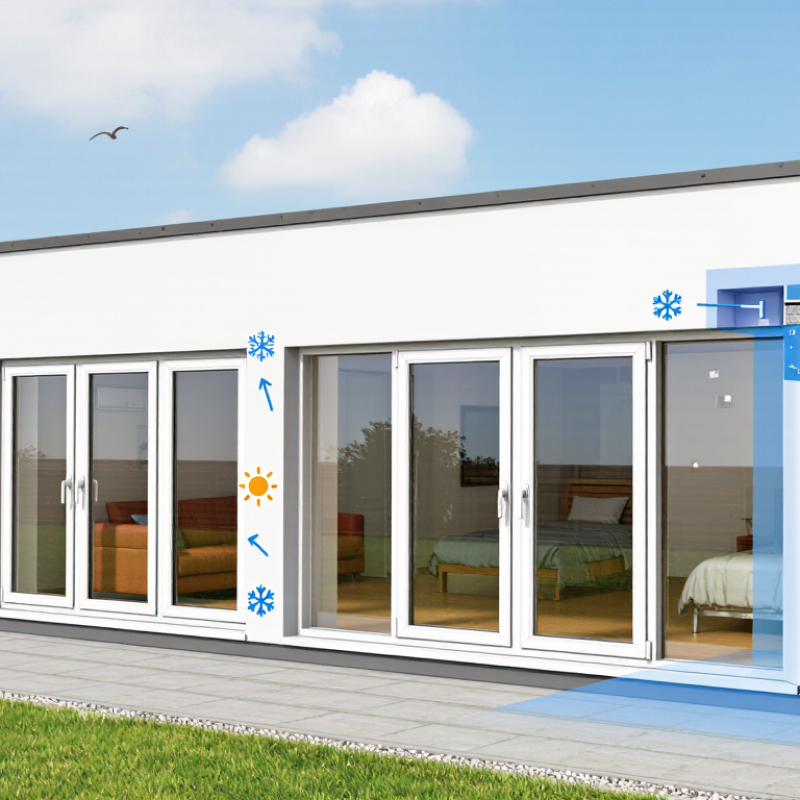
A practical 2026 target is a whole-window U-value, or Uw, below 1.3 W/m²K. Do not confuse it with Ug, the centre-glass value. EN ISO 10077 calculations include glazing, frames, spacers, and edge losses. Ask for certified Uw results, not sales estimates. The European Commission’s revised Energy Performance of Buildings Directive, Directive (EU) 2024/1275, pushes buildings toward much higher efficiency. The IEA’s Buildings 2023 report states that buildings consume about 30% of global final energy. Better windows can reduce heating demand, but performance depends on installation quality.
Look for double or triple glazing, warm-edge spacers, reinforced frames, and continuous perimeter sealing. A window rated at Uw 1.2 may perform poorly if foam gaps remain beside the frame. Measure it properly. Check the declared size, test method, glass configuration, and air-permeability class. EN 14351-1 supports this product-performance approach, while site workmanship still controls real comfort.
I would not treat 1.2 as automatically better. Oversized triple glazing can reduce useful daylight and increase cost. Solar exposure matters too. South-facing rooms may overheat, even with excellent insulation. The Passive House standard commonly uses windows near 0.8 W/m²K, but climate and orientation change the sensible choice. Request independent test evidence and installation photographs. A small thermal bridge can defeat an impressive laboratory number.
Classify UPVC profiles by EN 12608 wall-thickness and climate requirements
How to Choose UPVC Doors and Windows in 2026?
Classify UPVC profiles by EN 12608 wall-thickness and climate requirements
When choosing UPVC doors and windows, begin with the profile classification under EN 12608. This standard evaluates important wall-thickness requirements for UPVC profiles. Class A generally requires thicker external walls than Class B, while Class C has fewer prescribed thickness limits. However, thicker does not always mean better performance. The complete system matters.
Check the visible and non-visible wall dimensions in the supplier’s technical documents. A reliable supplier should provide test reports, profile drawings, and declared performance values. Ask how the profile handles wind pressure, welding stress, and long-term movement. Inspect the corners closely. Uneven weld lines can suggest weak fabrication, even when the profile looks substantial.
Climate changes the decision. In cold regions, choose profiles with suitable chambers, low-conductivity glazing, and strong weather seals. In hot, sunny areas, prioritize solar control glass and resistance to thermal expansion. Coastal homes need corrosion-resistant reinforcement, durable hardware, and careful drainage design. Heavy rainfall also requires properly positioned drainage channels.
Do not ignore installation.
A high-class profile can perform poorly when the frame is badly aligned or poorly sealed. I have seen specifications look impressive, yet condensation appeared around a poorly insulated reveal. That detail is easy to miss. Review the current local requirements, because EN 12608 classification alone does not prove energy efficiency, air tightness, or complete climate suitability.
Compare double and triple glazing using Ug values and low-E coatings
How to Choose UPVC Doors and Windows in 2026?
When comparing UPVC windows, begin with the Ug value. It measures heat loss through the glass, not the complete window. A lower Ug value usually means better insulation. Double glazing often reaches around 1.0–1.2 W/m²K. Triple glazing can fall near 0.6–0.8 W/m²K, depending on the specification. However, Ug alone can mislead you. Ask for the full Uw value, which includes the frame, spacer, and glass.
Low-E coatings help reflect indoor heat back into the room. They can also manage unwanted solar heat, depending on their position and design. Triple glazing may improve comfort beside a cold window on winter mornings. Yet it adds weight, cost, and sometimes reduces visible light. In a mild climate, quality double glazing may be the more balanced choice. I once focused too heavily on the lowest Ug value. The room felt better, but the installation details mattered more than expected. A poor seal can waste careful glass selection.
Tips: Compare Ug, Uw, and solar-control data together. Check the window’s orientation before choosing a coating. South-facing glass may need stronger solar control. North-facing glass often benefits from maximum insulation. Request tested performance figures, not vague claims. Also inspect the installer’s sealing method and drainage details. Small gaps can create noticeable drafts. Triple glazing is not automatically superior. Frame quality, airtight installation, ventilation, and local weather should guide the decision. Ask for written specifications and question figures that lack testing conditions.
How to Choose UPVC Doors and Windows in 2026?
Comparing double and triple glazing by representative centre-of-glass Ug values. Lower Ug values indicate better thermal insulation.
Standard double glazing with clear glass typically has a Ug value of about 2.8 W/m²K. Adding a low-E coating and an insulating gas cavity can reduce this to approximately 1.1 W/m²K. Triple glazing generally achieves around 0.7 W/m²K, while high-performance triple glazing with multiple low-E coatings can reach approximately 0.5 W/m²K. These are representative centre-of-glass values; the complete window or door U-value also depends on the UPVC frame, spacer, edge effects and installation quality.
Verify airtightness, watertightness, and wind resistance under EN standards
How to Choose UPVC Doors and Windows in 2026?
In 2026, do not judge UPVC doors and windows by appearance alone. Check performance evidence under relevant EN standards. For airtightness, ask for testing to EN 1026 and classification under EN 12207. A strong result helps reduce draughts, outside noise, and unnecessary heat loss. Request the complete test report, not only a sales claim.
Watertightness matters during wind-driven rain. EN 1027 measures water penetration, while EN 12208 provides the classification. Look for the stated pressure level and test conditions. Wind resistance should be tested under EN 12211 and classified under EN 12210. The frame, sash, glass, and hardware must work together. A high class can still perform poorly if installation leaves gaps around the opening. I have seen carefully tested products lose comfort because the fixing points were uneven. That detail is easy to underestimate.
Tips:
Inspect sample corners and gasket joints closely. Ask who performed the test and when it was completed. Confirm that the tested size resembles your planned door or window. Larger units may perform differently. Check installation instructions before ordering. Keep photographs of the opening and fitting process. This creates useful evidence if problems appear later. Also, question unclear terminology. “Weatherproof” sounds reassuring, but it does not replace an EN classification. A small showroom sample cannot prove performance in every building. Perhaps this is where buyers become too confident.
Assess installation quality, warranties, recyclability, and compliance records
Choosing UPVC doors and windows in 2026 requires more than comparing frame prices. Installation quality often determines real performance. The U.S. Department of Energy estimates that windows cause 25–30% of residential heating and cooling energy use. Ask for installer training records, product-specific fitting instructions, and site photographs. Check that frames sit squarely, seals remain continuous, and drainage paths are clear. A small gap can defeat an expensive specification.
Read warranties line by line. Separate the frame, glass, hardware, finish, and installation periods. Confirm who repairs failed seals, warped doors, or leaking joints. Also check exclusions, maintenance duties, response times, and whether the warranty transfers after a sale. Longer coverage is not automatically stronger. I once treated a ten-year warranty as decisive, but its installation exclusions made it nearly useless.
Recyclability needs evidence, not green wording. The VinylPlus 2024 Progress Report recorded more than 810,000 tonnes of PVC recycling in Europe during 2023. Ask whether the profile contains recycled content, and request its percentage by mass. Confirm whether the old frames will return to a documented recycling stream. Finally, request declarations of performance, conformity documents, test reports, and compliance records for the destination market. Relevant standards may include EN 14351-1, but paperwork must match the actual product and configuration. Labels can look impressive. Records matter more.